Contamination Removal System for Natural Gas TEG Dehydration

Remove salt from triethylene glycol (TEG) dehydration system online: lower cost, safer operations, less waste

Natural Gas Storage & Dehydration

Underground Natural Gas Storage and Why TEG Is Used

Natural gas is stored underground to balance year-round supply with seasonal and peak demand. Because it sits in contact with formation water and brine, withdrawn gas emerges saturated with water vapor.

Where Natural Gas Is Stored Underground

Depleted Reservoirs (~80% U.S. capacity)

Porous rock formations used for seasonal balancing. Withdrawn gas carries ancient brine, iron sulfide and trace hydrocarbons.

Salt Caverns (~10% U.S. capacity)

Fast-cycled voids in salt formations that deliver up to 26% of peak daily supply. Rapid withdrawal pulls high-chloride brine into the gas.

Aquifers (~9% U.S. capacity)

Water-bearing rock formations used where reservoirs or salt beds aren’t available. Withdrawal brings up mostly fresh or brackish water.

Why Triethylene Glycol (TEG) Is Used

Wet gas must be dried before entering pipelines, or water forms ice-like methane hydrates that block lines and drive corrosion. In the contactor, dry TEG absorbs the water; the reboiler boils it off at 375–400 °F (191–204 °C) so the TEG can be reused.

High Thermal Stability

Breaks down at 404 °F (207 °C)—well above DEG (~328 °F / 164 °C)—so it regenerates cleanly to 98–99.5% purity.

Deep Drying, Low Losses

Achieves an 80–140 °F dew-point depression with minimal vapor loss into the sales gas.

Continuous, Low-Cost Operation

More economical for bulk pipeline drying than molecular sieves, while MEG is mainly used for direct pipeline injection.

The Problem

Salt Builds Up in TEG Dehydration Systems

When gas is withdrawn from salt caverns or depleted reservoirs, brine carried in with the gas ends up in the TEG. In the reboiler, water boils off, but the dissolved salt stays behind—baking onto the fire tubes, degrading the glycol and driving corrosion, downtime and waste.

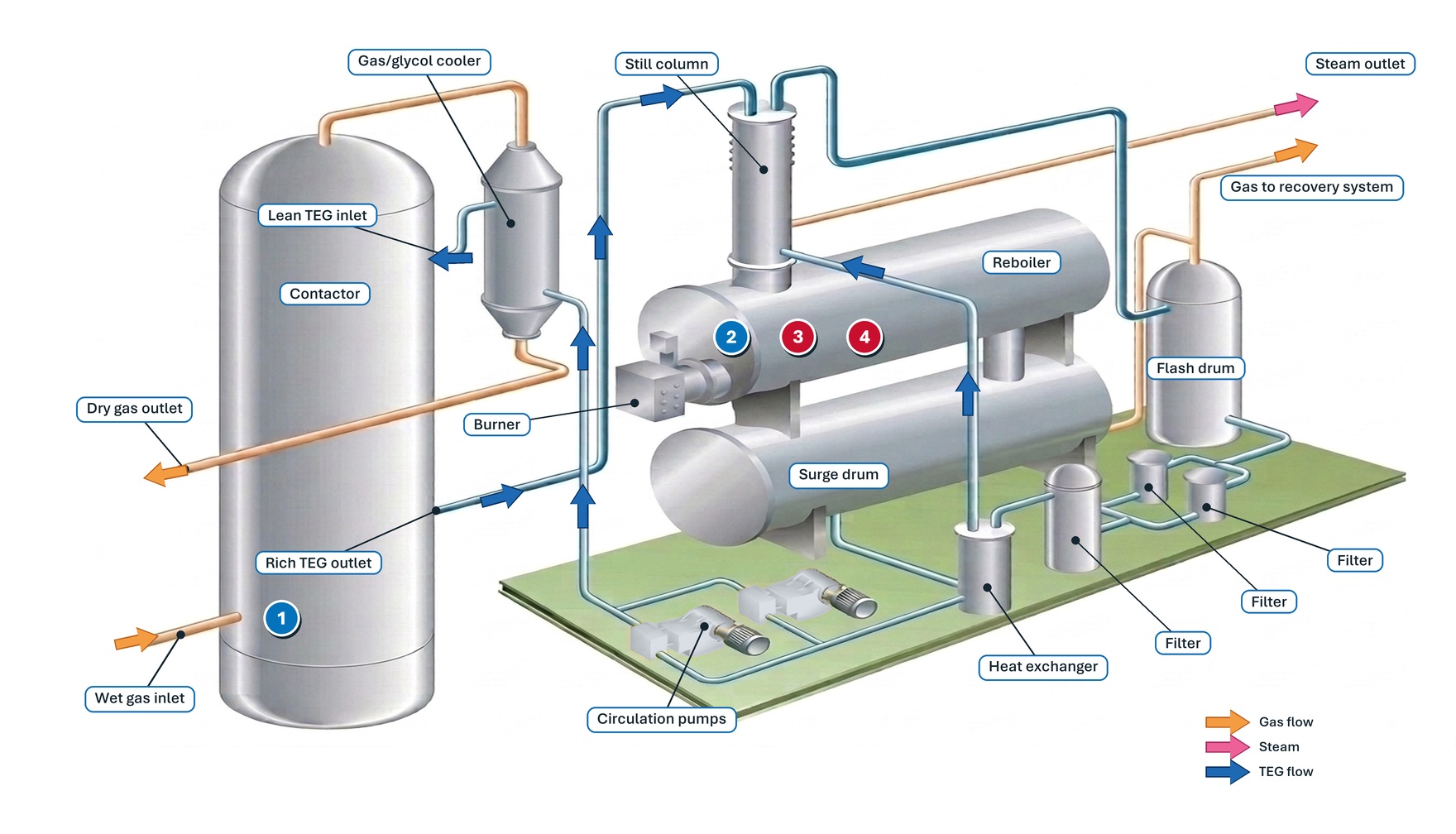
How the Problem Develops

1

Salt Enters

Brine carried in with the gas reaches the contactor.

2

Water Boils Off

The reboiler runs at 375–400 °F (191–204 °C) and leaves the salt in the TEG.

3

Salt Bakes On

Chloride fouls and pits the fire tubes, and insulates them.

4

TEG Breaks Down

Overheating past 404 °F (207 °C) turns TEG to acids (pH < 6.5) and sludge.

A typical TEG dehydration system: salt enters at the contactor and concentrates in the reboiler.

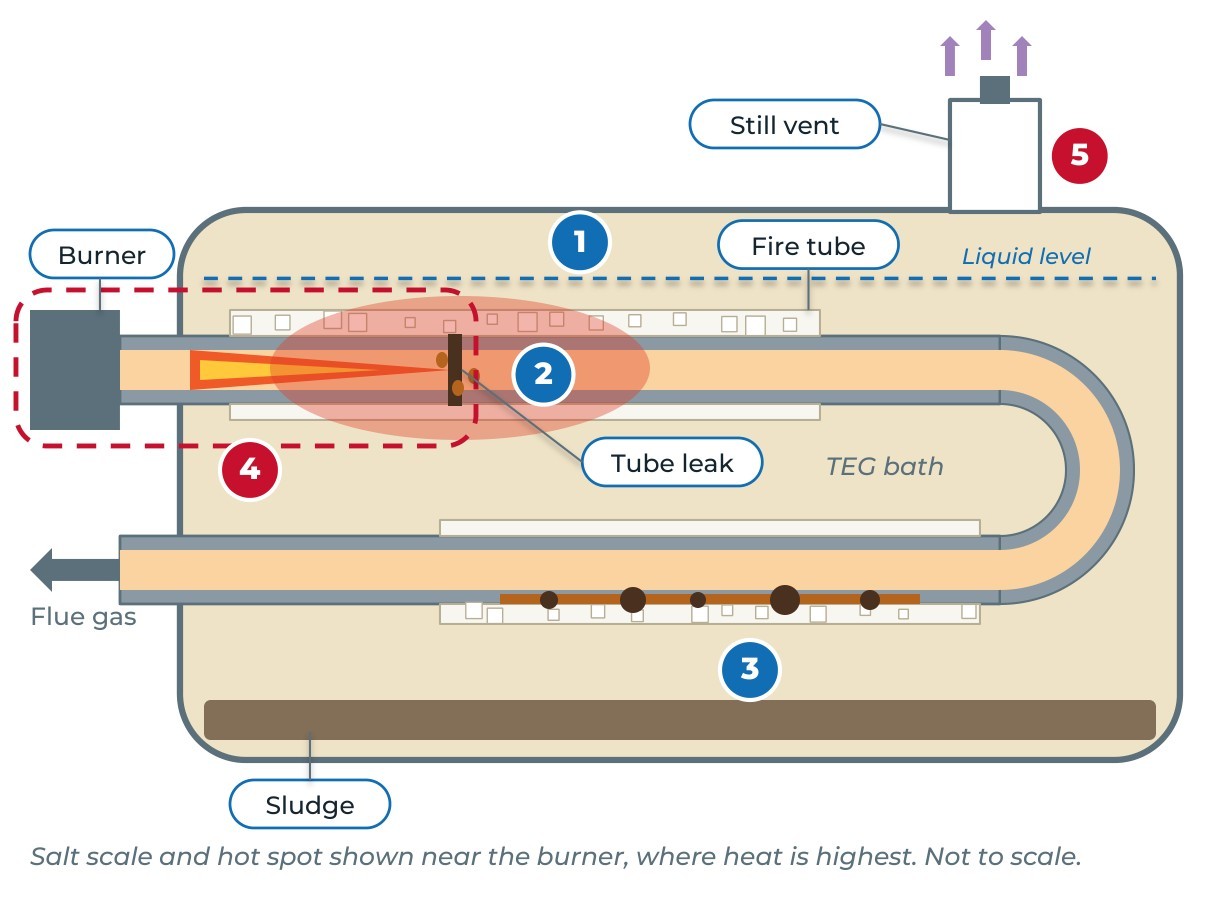
How Salt Damages the Reboiler

Salt scale, hot spots and corrosion feed each other, and can raise fire and EPA permit risk.

1

Fouling

Salt scale insulates the fire tube. Less heat reaches the TEG, so the wall runs hotter.

2

Hot Spots

Scaled spots can push TEG past its 404 °F (207 °C) breakdown point, forming acids and sludge.

3

Corrosion

Chloride and TEG acids (pH below 6.5) pit steel under deposits, which can lead to tube leaks.

4

Fire Risk

A leak can let hot, combustible TEG reach the flame.

5

Toxic Venting

Overheated TEG can vent toxic gases, a possible EPA permit issue. Glycol still-vent hazardous air pollutants (BTEX, including benzene) are regulated under U.S. EPA 40 CFR Part 63 Subparts HH (production) and HHH (transmission and storage); applicability depends on source type and size. No EPA rule specifically requires removing salts or chlorides from TEG.

What It Costs

Safety

Fire-tube hot spots raise the risk of tube failure and leaks. Overheated TEG can vent toxic gases, a possible EPA permit issue.

Reliability

Corrosion, sludge and plugged filters wear out pumps and exchangers, causing unplanned downtime and off-spec dry gas.

Cost and Waste

Glycol replacement and disposal, and turnaround cleanouts such as hydro blasting and confined-space entry.

Filters can’t remove dissolved salt. Inlet separation and filters reduce solids and hydrocarbons, but not dissolved chlorides. Replacing or reclaiming glycol adds recurring cost and waste disposal, and often needs planned downtime.

The Solution

CRS Series

Dynalene Contamination Removal System for TEG Dehydration

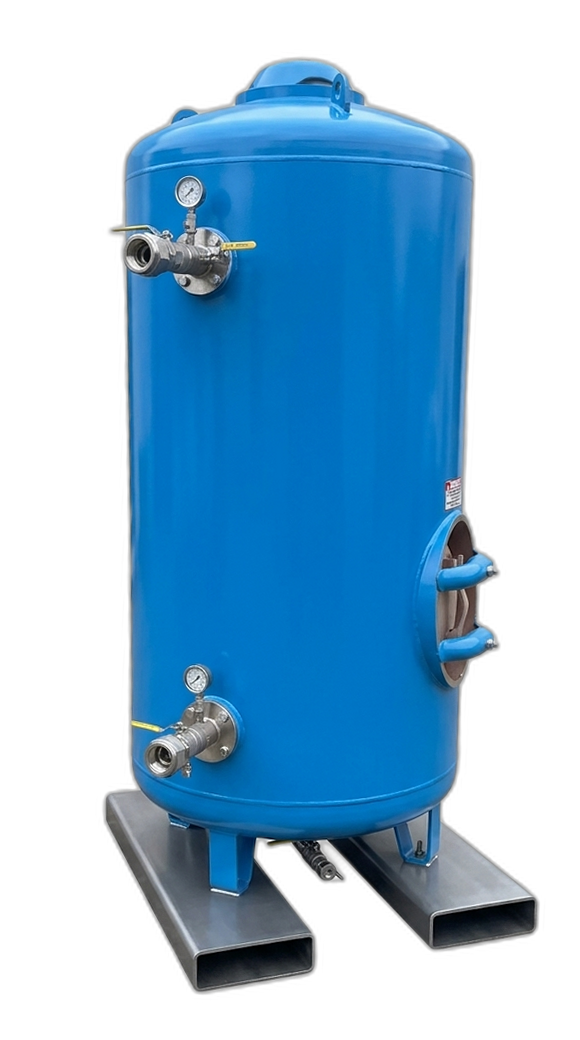
Skid-mounted ion exchange that removes salt from TEG while the dehydrator keeps running

The Dynalene CRS uses a mixed-bed (cation and anion) ion exchange resin to remove chloride, sulfate and other salts, plus TEG degradation acids, from a slip-stream of TEG. Cleaned glycol returns to the system, so you reclaim your TEG on site instead of replacing it, and protect the reboiler from fouling, corrosion and hot spots.

Ion exchange runs online on a slip-stream with a low energy footprint and low operating cost, and it removes the ionic contaminants without stressing the TEG. Unlike vacuum distillation, it doesn’t put the glycol through another thermal cycle.

Where it fits: ion exchange is best suited to brine-driven chloride contamination, such as salt caverns and depleted reservoirs. Iron sulfide and liquid hydrocarbons can blind the resin, so pre-filtration is added in those environments.

Features

What It Removes

Dynalene Contamination Removal System
Footprint: 36″ × 42″ × 82″

Lower Cost & Zero Downtime

>50% projected savings by reclaiming TEG instead of buying virgin, with zero downtime. Slip-stream operation kept the dehydration towers online. Savings depend on system volume, initial salt concentration, virgin TEG pricing, and local waste disposal costs.

Safer Operations

Protects the reboiler from fouling, corrosion and hot spots. Less overheating can mean fewer toxic vent emissions, a potential EPA permit issue. Fewer cleanouts also mean less hydroblasting, confined-space entry and hot work.

Less Waste

Reclaiming TEG on site avoids buying and shipping new glycol, which is made from fossil-based ethylene oxide, and cuts truck trips for fresh glycol in and spent glycol out.
How It Works

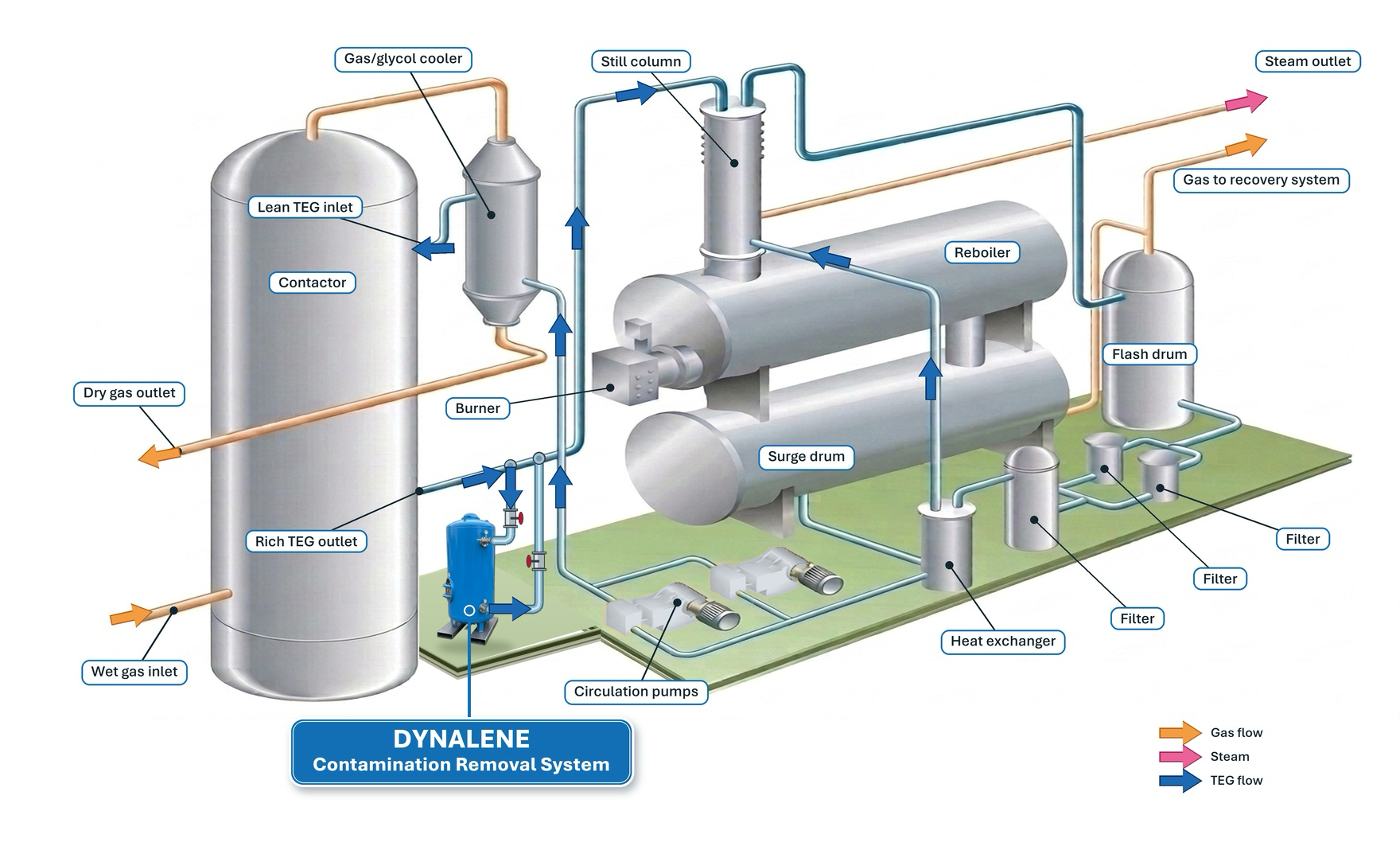
Slip-Stream Ion Exchange for TEG Dehydration Systems

The Dynalene CRS pulls salt out of the TEG while the dehydrator keeps running.

1

Tap

A small slip-stream of rich TEG is drawn off the line.

2

Capture

Mixed-bed resin removes salts and TEG degradation acids.

3

Return

Cleaned TEG rejoins the line and carries on to the still column.

4

Keep Running

The dehydrator keeps running while the Dynalene CRS works alongside it.

The Dynalene CRS connects on a slip-stream to the rich TEG line, between the contactor and the still column.

Filters can’t remove dissolved salt. Inlet separation and filters reduce solids and hydrocarbons, but not dissolved chlorides. Replacing or reclaiming glycol adds recurring cost and waste disposal, and often needs planned downtime.

Case Study · Gill Ranch Storage, California

Removing Salt from a Natural Gas TEG Dehydration System

On-site TEG reclamation with Dynalene’s ion exchange system.

The Problem

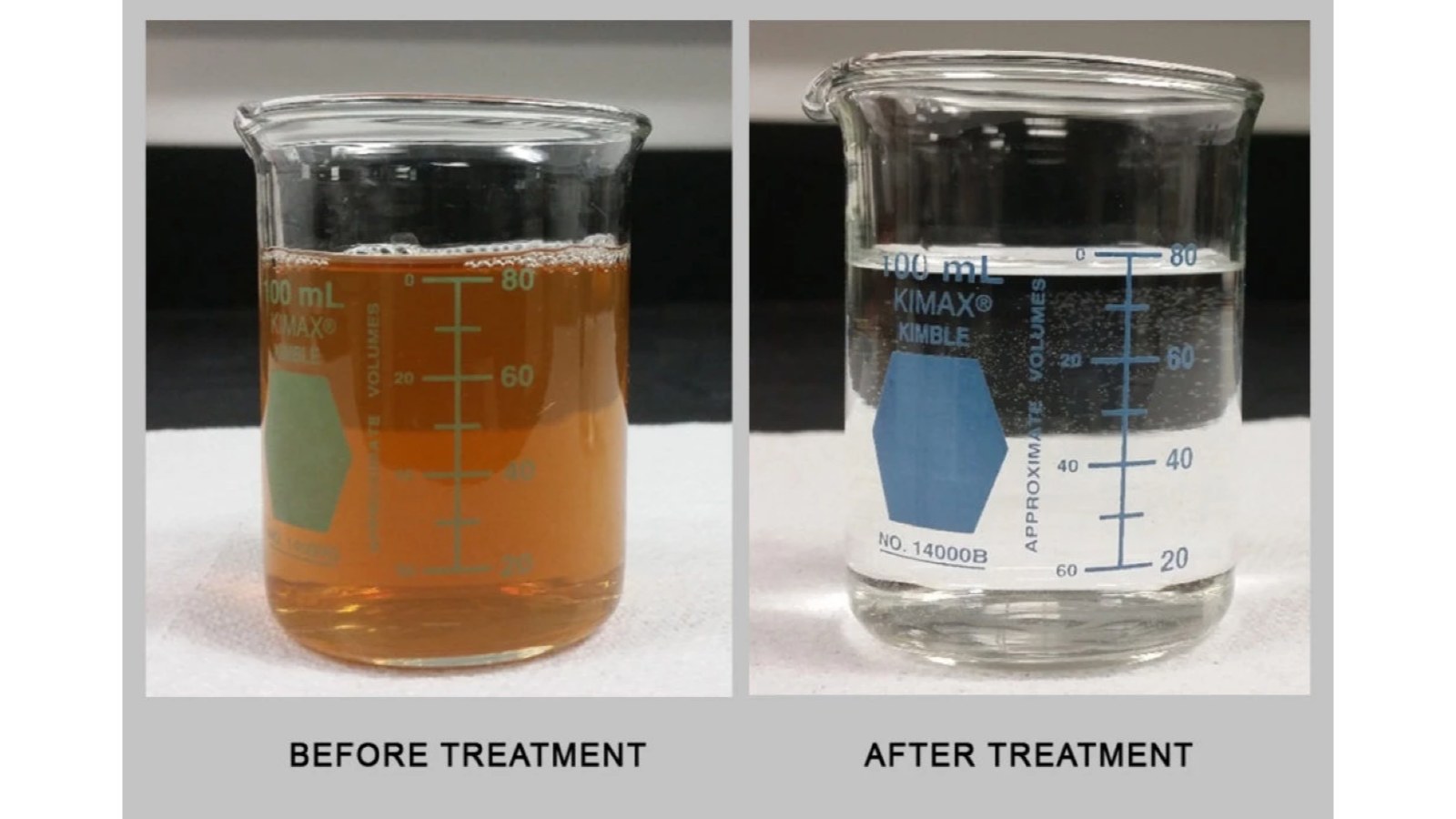
Salt-rich water pushed chloride in the TEG to 2,486 ppm.

Risks: corrosion, hot spots, lower dehydration efficiency.

The Solution

A skid-mounted Dynalene Contamination Removal System on a slip-stream: 5-µm filtration plus multistage high-capacity ion exchange at 10–15 GPM. Chloride fell from 2,486 ppm to 75.6 ppm in 46 hours, and the dehydration towers stayed online.

TEG restored. Before: dark brown TEG at 2,486 ppm chloride. After: clear TEG at 75.6 ppm.

97%

Chloride removed
2,486 ppm → 75.6 ppm

46 hrs

Continuous slip-stream circulation

7,500 gal

TEG reclaimed on-site

Zero

Downtime

>50%*

Projected cost savings vs. virgin TEG

Source: Dynalene case study, January 2019. *Projected for a project similar to Gill Ranch vs. virgin TEG; not a measured Gill Ranch result.

Videos

See It In Action

Watch product overviews, installation walkthroughs, and real-world application demonstrations for Dynalene ion exchange systems.

IC Series Product Overview

Cartridge Installation & Replacement Guide

DYI Series: On-Site DI Water Generation

Get Started

How Can We Help?

From first call to custom skid and beyond, we’re with you.

Request a Quote or Information

Sizing, pricing and technical data for your system. Send us your TEG volume, flow rate and chloride level and we’ll respond as soon as possible.

Talk to an Engineer

Set up an introductory call: 30 minutes with a Dynalene team to review your TEG system and goals, or discuss a custom skid built for your flow, temperature and TEG conditions.

Submit a Fluid Sample

Send a TEG sample to Dynalene Labs. We test chloride, pH and degradation markers, then recommend the right system and size.

Type here to search

⚡ Quick Quote

We'll respond as soon as possible

Great! We’ve received your request.

⚙️ Talk to an Engineer

Custom solutions for your application

Great! We’ve received your request.

Submit Fluid Sample

Send your coolant sample to Dynalene Labs

Great! We’ve received your request.